#FutureFirstThinking - See How Technologists Can Lead Business Transformation(1)

#FutureFirstThinking – See How Technologists Can Lead Business Transformation

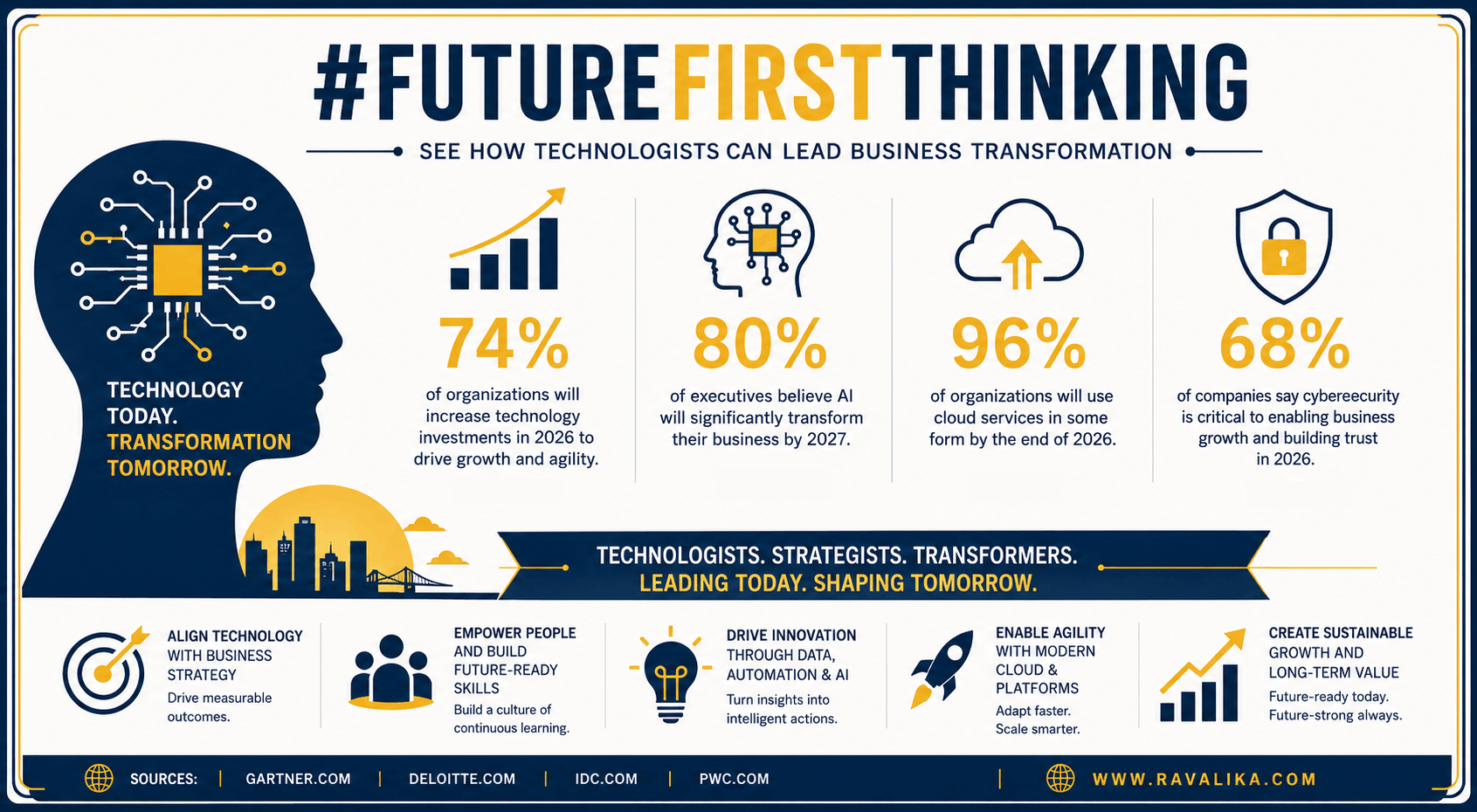
The world’s most successful organizations are no longer defined by the products they sell or the markets they serve. Instead, they are distinguished by how effectively they anticipate change, embrace innovation, and transform themselves before disruption forces them to. This shift has given rise to a new way of thinking – Future First Thinking.

Future First Thinking is more than predicting trends or adopting the latest technologies. It is a strategic mindset that encourages organizations to make decisions today based on the opportunities and challenges of tomorrow. It requires leaders to move beyond quarterly goals and immediate operational concerns to envision what their business, customers, and industries will look like five or even ten years from now.

At the center of this transformation are technologists. Once viewed primarily as architects of software and infrastructure, today’s technologists are becoming business strategists, innovation leaders, and catalysts for organizational change. They possess a unique understanding of emerging technologies and are increasingly responsible for translating technical capabilities into measurable business value.

The organizations that will dominate the next decade won’t necessarily have the biggest budgets or the largest workforces. They will have leaders who combine technological expertise with strategic thinking to build businesses that are resilient, intelligent, and ready for whatever comes next.

The Rise of Future First Thinking

Every major business revolution has been driven by a shift in mindset before it was driven by technology. The Industrial Revolution introduced mechanization. The Digital Revolution connected the world. Today, Artificial Intelligence, automation, cloud computing, quantum computing, spatial computing, and intelligent data platforms are driving another transformation.

However, technology alone doesn’t create competitive advantage. The ability to identify opportunities before competitors and adapt faster than the market does.

Future First Thinking encourages organizations to ask different questions.

  • What emerging technologies will redefine customer expectations?
  • Which business models could become obsolete within five years?
  • What new skills should employees develop today?
  • How can technology become a strategic growth engine instead of simply an operational tool?

These questions shift organizations from reacting to disruption toward actively creating the future.

Why Technologists Are Becoming Business Leaders

For decades, business strategy and technology strategy existed in separate worlds. Executives defined the vision while technology teams implemented it.

That separation no longer exists.

Today, almost every strategic initiative depends on technology.

Whether it’s expanding into new markets, improving customer experience, optimizing operations, launching digital services, or adopting AI, technology is no longer supporting the business – it is the business.

This evolution has elevated technologists into strategic leadership roles because they understand both possibilities and limitations. They recognize how emerging technologies can unlock entirely new business opportunities long before they become mainstream.

Organizations increasingly seek leaders who can speak both the language of technology and the language of business.

Characteristics of Future First Leaders

Future-focused technologists share several common characteristics that distinguish them from traditional technology leaders.

They Think Beyond Today’s Problems

Rather than simply solving immediate challenges, they design systems capable of adapting to future requirements.

Instead of asking:

“How do we improve this process?”

They ask:

“Will this process even exist in five years?”

This subtle difference changes how organizations invest, innovate, and compete.

They Connect Technology to Business Outcomes

Successful transformation isn’t measured by how many AI tools an organization deploys.

It’s measured by outcomes such as:

  • Faster innovation
  • Better customer experiences
  • Increased operational efficiency
  • Higher employee productivity
  • Sustainable business growth

Future First leaders focus on business impact rather than technology adoption alone.

They Make Decisions Using Data

Intuition remains valuable, but modern organizations have access to enormous amounts of information.

Future-focused leaders combine experience with data-driven insights.

Predictive analytics, AI-powered forecasting, customer intelligence, and operational dashboards enable better strategic decisions while reducing uncertainty.

They Build Continuous Learning Cultures

Technology evolves faster than traditional organizational structures.

The most successful companies recognize that continuous learning has become a competitive advantage.

Future First leaders encourage experimentation, certifications, knowledge sharing, cross-functional collaboration, and curiosity.

Learning is no longer an event.

It becomes part of organizational culture.

Technology Trends Reshaping Business Transformation

Future First Thinking requires understanding not only current innovations but also their long-term implications.

Several technologies are reshaping business faster than any previous generation has experienced.

Artificial Intelligence

AI is transforming every department – from finance and HR to marketing, manufacturing, healthcare, and customer service.

Organizations are moving beyond automation toward intelligent decision support, predictive analytics, personalized experiences, and autonomous workflows.

The next wave will focus on AI agents collaborating alongside employees rather than replacing them.

Intelligent Automation

Automation is evolving beyond repetitive tasks.

Modern automation combines robotic process automation, machine learning, computer vision, and natural language processing to handle increasingly complex business processes.

Organizations adopting intelligent automation improve speed, reduce errors, and free employees to focus on higher-value work.

Cloud-Native Enterprises

Cloud has become the foundation for business agility.

Instead of maintaining expensive infrastructure, organizations can rapidly scale operations, deploy applications globally, and experiment with new ideas at significantly lower cost.

Cloud platforms also accelerate innovation by providing immediate access to AI services, analytics, cybersecurity, and advanced development tools.

Cybersecurity as Strategy

Cybersecurity is no longer simply an IT responsibility.

Customer trust has become one of the most valuable business assets.

Organizations that integrate security into every digital initiative strengthen brand reputation while reducing operational risk.

Future First Thinking treats cybersecurity as a business differentiator.

Data as a Strategic Asset

Every interaction generates valuable information.

Organizations capable of converting raw data into actionable insights make better decisions, personalize customer experiences, and identify new revenue opportunities faster than competitors.

The future belongs to businesses that understand data—not simply those that collect it.

Building a Future Ready Organization

Technology alone cannot transform a business.

Transformation begins with people, leadership, and culture.

Create a Clear Vision

Employees support transformation when they understand why change matters.

A compelling vision aligns technology investments with long-term business objectives and provides clarity during periods of uncertainty.

Empower Cross-Functional Collaboration

Innovation rarely happens inside organizational silos.

Future-ready companies encourage collaboration among engineering, marketing, operations, finance, customer support, HR, and executive leadership.

Diverse perspectives generate stronger ideas.

Encourage Responsible Experimentation

Innovation requires calculated risk-taking.

Organizations should establish environments where employees can prototype ideas, test assumptions, learn from failures, and scale successful initiatives without fear of blame.

Small experiments often produce breakthrough innovations.

Invest in Digital Skills

Technology changes rapidly.

Organizations that continuously develop digital capabilities – from AI literacy to data analytics and cybersecurity – remain competitive regardless of industry.

People remain the greatest driver of transformation.

Challenges Every Technologist Must Overcome

Business transformation is rarely straightforward.

Future First leaders frequently encounter common obstacles.

Resistance to Change

Employees naturally prefer familiar processes.

Successful leaders communicate the benefits of transformation while involving teams throughout the journey.

Legacy Systems

Many organizations depend on aging infrastructure.

Rather than attempting complete replacement overnight, future-focused leaders modernize systems incrementally while minimizing business disruption.

Skill Gaps

Emerging technologies often outpace workforce capabilities.

Continuous learning programs help organizations remain adaptable without relying solely on external hiring.

Innovation Fatigue

Too many initiatives without clear priorities can overwhelm teams.

Future First Thinking emphasizes focused innovation aligned with measurable business outcomes instead of chasing every emerging trend.

The Technologist’s New Responsibility

The role of today’s technologist extends far beyond writing code or managing infrastructure.

Modern technologists influence strategy.

They shape customer experiences.

They improve operational resilience.

They identify new business opportunities.

They help organizations anticipate change rather than simply react to it.

The most successful technology leaders possess curiosity, business acumen, communication skills, empathy, and the ability to unite people around a shared vision.

Technology expertise opens the door.

Strategic thinking creates lasting impact.

Looking Beyond Tomorrow

Perhaps the greatest lesson from the past decade is that disruption arrives faster than expected.

Few organizations anticipated the speed of AI adoption, remote work, digital ecosystems, or intelligent automation.

The next decade will introduce innovations that are equally transformative.

Companies that wait for certainty will always be responding to someone else’s innovation.

Companies practicing Future First Thinking will be creating it.

My Thoughts

Business transformation is no longer a destination – it is a continuous capability. In an era defined by rapid technological advancement, economic uncertainty, and evolving customer expectations, organizations need leaders who can connect vision with execution and innovation with measurable outcomes.

Technologists are uniquely positioned to lead this transformation because they understand how emerging technologies intersect with business strategy. But success requires more than technical expertise. It demands curiosity, adaptability, collaboration, and the courage to challenge conventional thinking.

Future First Thinking is ultimately about making better decisions today that prepare organizations for tomorrow. It encourages leaders to embrace change before it becomes necessary, invest in people as much as technology, and build cultures that continuously learn and evolve.

The future will not be shaped by those who simply adopt new technologies. It will belong to those who use technology to reimagine industries, redefine customer experiences, and create lasting business value.

The future doesn’t wait. The best time to build it is now.

Ravalika Medipally

Tech Influencer, Business Strategist, Product Manager with 10+ years of experience in driving innovation and growth across diverse industries. With over a decade of technology industry experience, I provide guidance to organizations through digital transformation, strategic planning, enterprise risk management, go-to-market optimization, and influencer marketing.

Leave a Reply

Your email address will not be published. Required fields are marked *