For decades, the path to building a billion-dollar company followed a familiar formula. Entrepreneurs raised capital, hired teams, expanded operations, built departments, established management layers, and scaled through people. The larger the company became, the larger the workforce required to support it. Success was often measured by office space, employee count, and organizational complexity.
That equation is beginning to change. Advances in Artificial Intelligence, automation, cloud computing, and digital platforms are creating a future where a single individual may be capable of building and operating a company that generates hundreds of millions or even billions of dollars in value. While the idea may sound ambitious today, the foundations are already visible. Across industries, entrepreneurs are leveraging AI-powered tools to perform tasks that once required entire teams, signaling the emergence of a new era: the rise of the one-person billion-dollar company.
The Great Shift from Workforce to Intelligence
The Industrial Age rewarded ownership of physical assets. The Information Age rewarded access to information. The AI Age rewards access to intelligence.
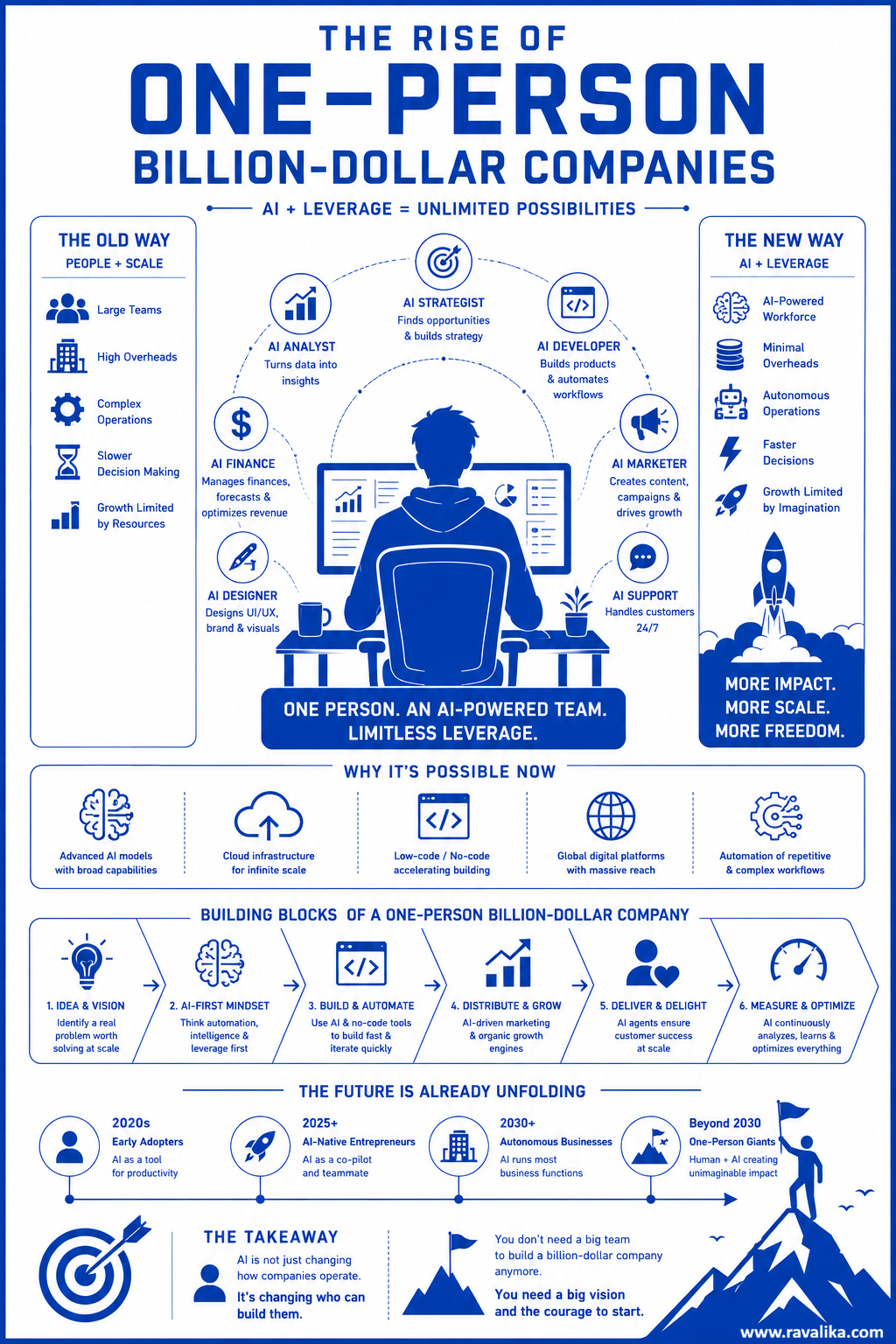
For the first time in history, entrepreneurs can acquire on-demand expertise without hiring large teams. AI systems can write code, generate content, analyze data, create marketing campaigns, provide customer support, and assist with strategic planning. Instead of building departments, founders can assemble digital workforces composed of intelligent software agents.
This shift fundamentally changes how companies scale. Historically, growth required proportional increases in headcount. More customers meant more employees. More products meant more managers. More operations meant more infrastructure.
AI breaks this relationship.
A single founder can now manage workflows that previously demanded dozens or even hundreds of employees. The result is a dramatic reduction in operational complexity and an unprecedented increase in entrepreneurial leverage.
The Emergence of AI Employees
The modern entrepreneur is no longer working alone.
They are increasingly supported by AI systems acting as researchers, marketers, designers, developers, analysts, and virtual assistants. Unlike traditional employees, these systems work continuously, scale instantly, and improve through learning.
Imagine a founder launching a software product in 2030.
An AI product strategist identifies market opportunities. An AI designer creates the user interface. An AI developer writes the application code. An AI marketing specialist generates campaigns and content. An AI customer service agent handles support inquiries. An AI financial advisor monitors cash flow and forecasting.
The founder’s role evolves from performing tasks to orchestrating intelligence.
In this model, businesses become less about managing people and more about directing networks of autonomous digital agents.
Why Cloud Infrastructure Changes Everything
The rise of one-person billion-dollar companies would not be possible without cloud technology.
A few decades ago, launching a global business required significant investments in hardware, offices, distribution channels, and technical infrastructure. Today, entrepreneurs can access enterprise-grade computing resources on demand.
Cloud platforms have transformed technology from an asset into a utility.
A founder with a laptop can launch products accessible worldwide, store massive amounts of data, process transactions across continents, and scale operations instantly without owning physical infrastructure.
The barriers that once protected large organizations are disappearing.
Technology that was previously available only to multinational corporations is now accessible to anyone with an internet connection and a compelling idea.
The Rise of Autonomous Business Operations
One of the most fascinating developments in the AI era is the emergence of autonomous business operations.
Modern businesses consist of thousands of repetitive decisions. Scheduling meetings, managing invoices, generating reports, tracking customer interactions, optimizing marketing spend, and monitoring performance metrics all consume valuable time.
AI agents are increasingly capable of handling these responsibilities independently.
Future businesses may operate with minimal human intervention. Systems will continuously monitor market conditions, adjust pricing, launch campaigns, allocate resources, and identify opportunities for growth.
Entrepreneurs will spend less time managing operations and more time focusing on vision, innovation, and strategic direction.
This shift represents one of the most significant productivity revolutions in modern business history.
The Economics of Infinite Scale
Traditional businesses face scaling challenges because costs increase with growth.
Hiring more employees increases payroll expenses. Expanding operations requires additional infrastructure. Managing larger organizations introduces complexity and inefficiencies.
Digital businesses operate differently.
Once a digital product is created, serving additional customers often costs very little. AI amplifies this advantage by automating many activities associated with growth.
A single founder who creates a successful AI-powered platform can potentially serve millions of users without building a massive workforce.
This creates a new economic reality where revenue and organizational size become increasingly disconnected.
Future billion-dollar companies may have fewer than ten employees or perhaps only one.
The implications for entrepreneurship, employment, and wealth creation are profound.
The New Entrepreneurial Skillset
As technology automates execution, human value shifts toward higher-order capabilities.
The entrepreneurs who thrive in this environment will not necessarily be the best programmers, marketers, or operators. Instead, they will excel at identifying opportunities, solving meaningful problems, and making strategic decisions.
Several skills are becoming increasingly important:
- Vision and long-term thinking
- Creativity and innovation
- Systems thinking
- Ethical decision-making
- Human-centered design
- Relationship building
- Adaptability and continuous learning
AI can generate solutions, but humans still define which problems are worth solving.
The future entrepreneur becomes a curator of intelligence rather than a manager of resources.
The Democratization of Billion-Dollar Opportunities
Historically, building a large company often required access to capital, influential networks, specialized knowledge, and geographic advantages.
AI is democratizing access to many of these resources.
A talented entrepreneur in a small town can access the same AI capabilities available to executives in major technology hubs. Knowledge, expertise, and operational support are becoming increasingly accessible.
This democratization has the potential to unleash a wave of innovation from regions and communities that were previously underrepresented in the global startup ecosystem.
The next billion-dollar company may emerge not from Silicon Valley but from a remote village, a college dorm room, or a home office anywhere in the world.
Talent is becoming more important than location.
Ideas are becoming more important than infrastructure.
The Human Challenges Ahead
While the opportunities are extraordinary, the rise of one-person billion-dollar companies also raises important questions.
What happens when fewer employees are needed to create economic value?
How will societies adapt to changing employment patterns?
How will wealth be distributed in an economy where small teams generate enormous value?
The transition will likely create both opportunities and disruptions.
New categories of work will emerge, while some traditional roles may decline. Education systems, governments, and businesses will need to rethink how people develop skills and participate in the economy.
The future will require a balance between technological advancement and human well-being.
Success should not be measured solely by efficiency but also by the positive impact technology creates for individuals and communities.
The Role of Trust in an AI-Driven Economy
As AI becomes more capable, trust will become one of the most valuable assets in business.
Customers increasingly interact with digital systems rather than human representatives. Content, products, and services may be generated or delivered by AI.
In such an environment, people will seek brands and leaders they can trust.
Transparency, authenticity, accountability, and ethical leadership will become powerful differentiators.
Ironically, as technology becomes more sophisticated, human qualities become more important.
The entrepreneurs who combine AI capabilities with genuine human values will be best positioned to build lasting businesses.
Looking Beyond 2030
The one-person billion-dollar company may seem extraordinary today, but history suggests that transformative technologies consistently reshape what is possible.
There was a time when global communication seemed impossible. There was a time when carrying a supercomputer in your pocket sounded unrealistic. There was a time when online commerce appeared experimental.
Each of these innovations eventually became part of everyday life.
AI represents another such transformation.
Over the next decade, we are likely to witness entrepreneurs achieving levels of productivity and impact that would have been unimaginable just a few years ago. The organizations of the future may look fundamentally different from those of the past.
My Thoughts
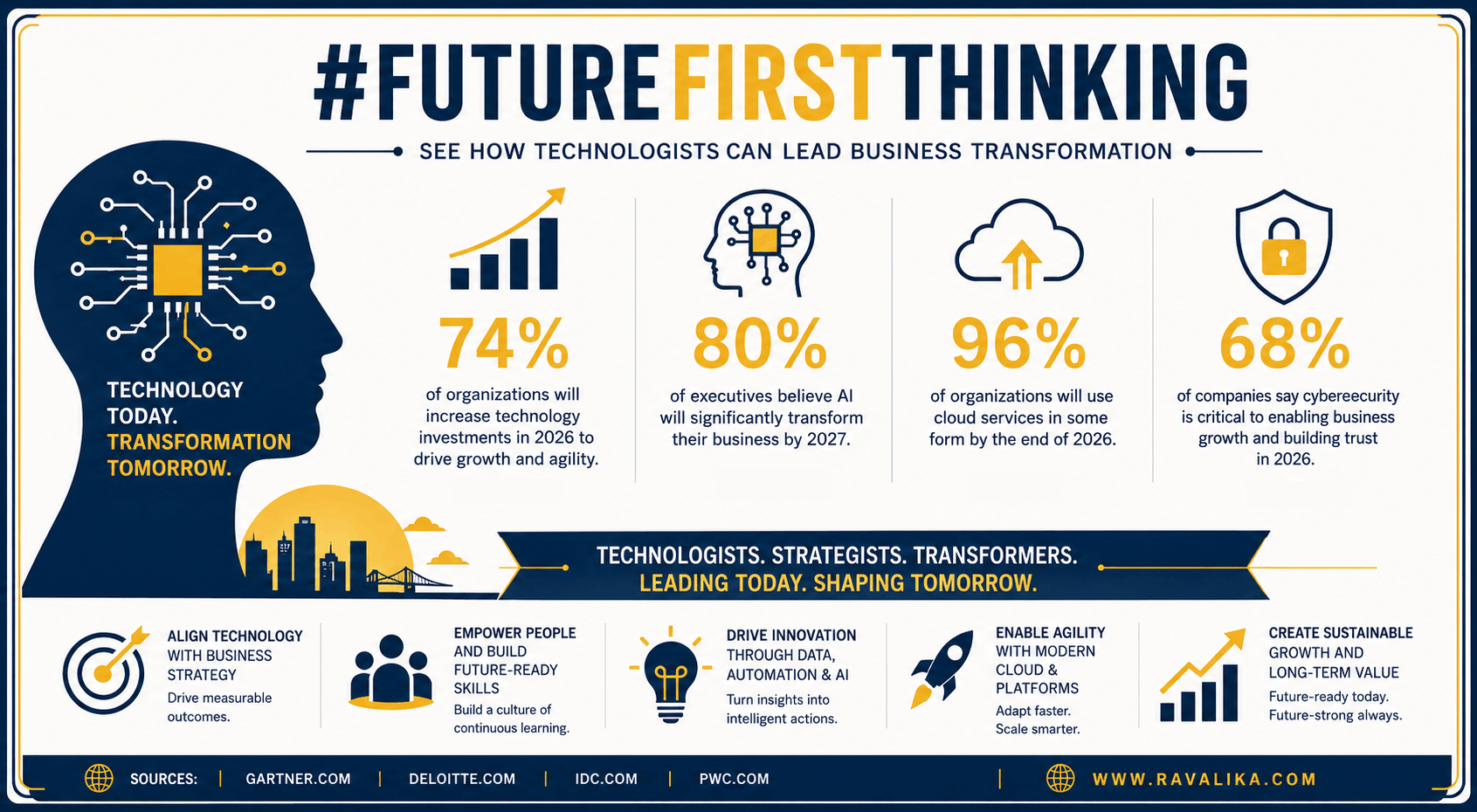
The rise of one-person billion-dollar companies is not merely a technology story. It is a story about leverage. Artificial Intelligence is providing individuals with capabilities that were once available only to large organizations. The combination of AI, cloud infrastructure, automation, and global connectivity is creating a new entrepreneurial landscape where a single person can build products, reach customers, and generate value at unprecedented scale.
The future belongs to those who learn how to collaborate with intelligent systems rather than compete against them. While technology will continue to automate tasks, human imagination, purpose, creativity, and leadership will remain irreplaceable. The next generation of iconic companies may not be defined by the number of people they employ but by the magnitude of impact they create. The era of the one-person billion-dollar company is no longer a distant possibility – it is rapidly becoming one of the defining business trends of the AI age.