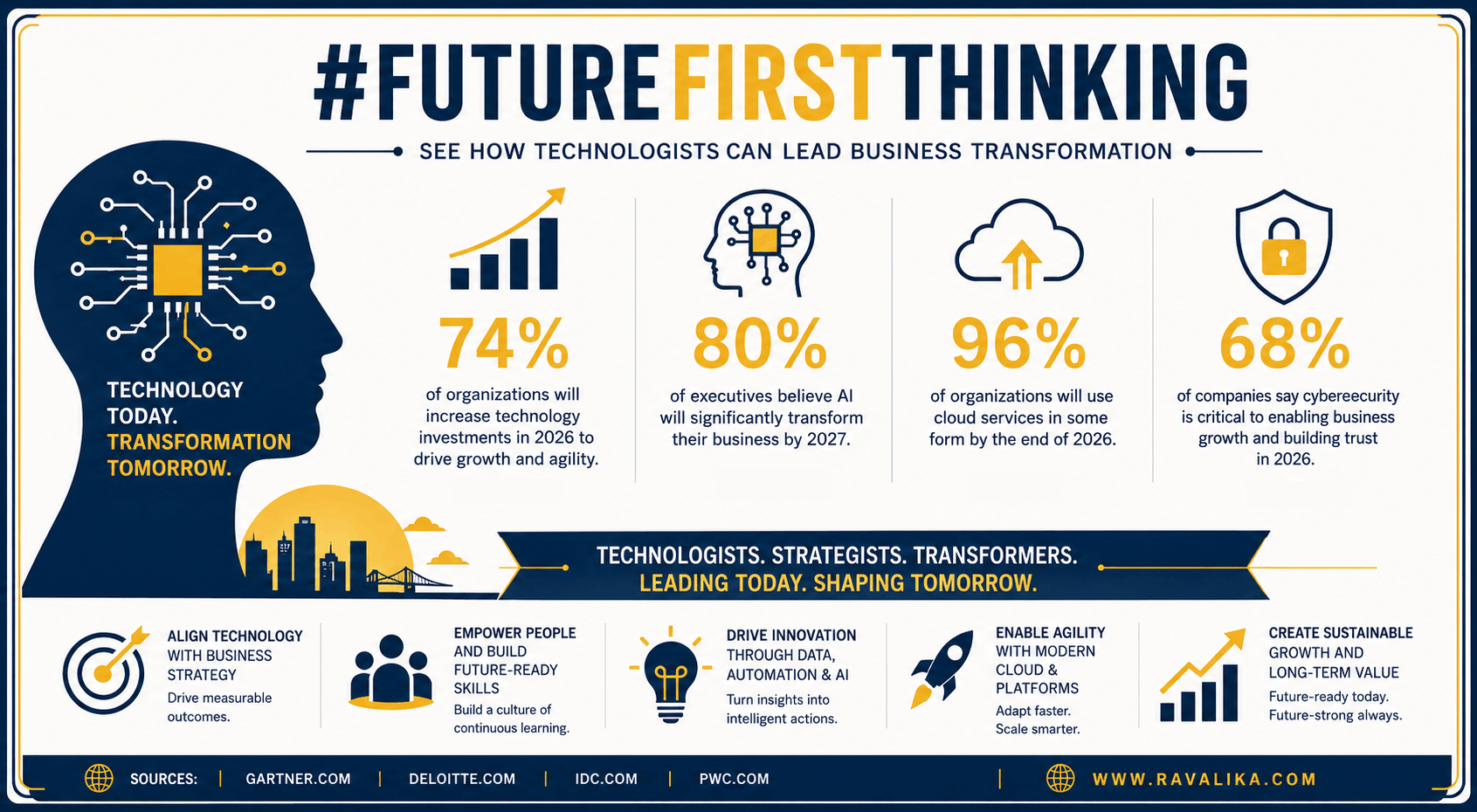
The world’s most successful organizations are no longer defined by the products they sell or the markets they serve. Instead, they are distinguished by how effectively they anticipate change, embrace innovation, and transform themselves before disruption forces them to. This shift has given rise to a new way of thinking – Future First Thinking.
Future First Thinking is more than predicting trends or adopting the latest technologies. It is a strategic mindset that encourages organizations to make decisions today based on the opportunities and challenges of tomorrow. It requires leaders to move beyond quarterly goals and immediate operational concerns to envision what their business, customers, and industries will look like five or even ten years from now.
At the center of this transformation are technologists. Once viewed primarily as architects of software and infrastructure, today’s technologists are becoming business strategists, innovation leaders, and catalysts for organizational change. They possess a unique understanding of emerging technologies and are increasingly responsible for translating technical capabilities into measurable business value.
The organizations that will dominate the next decade won’t necessarily have the biggest budgets or the largest workforces. They will have leaders who combine technological expertise with strategic thinking to build businesses that are resilient, intelligent, and ready for whatever comes next.
The Rise of Future First Thinking
Every major business revolution has been driven by a shift in mindset before it was driven by technology. The Industrial Revolution introduced mechanization. The Digital Revolution connected the world. Today, Artificial Intelligence, automation, cloud computing, quantum computing, spatial computing, and intelligent data platforms are driving another transformation.
However, technology alone doesn’t create competitive advantage. The ability to identify opportunities before competitors and adapt faster than the market does.
Future First Thinking encourages organizations to ask different questions.
- What emerging technologies will redefine customer expectations?
- Which business models could become obsolete within five years?
- What new skills should employees develop today?
- How can technology become a strategic growth engine instead of simply an operational tool?
These questions shift organizations from reacting to disruption toward actively creating the future.
Why Technologists Are Becoming Business Leaders
For decades, business strategy and technology strategy existed in separate worlds. Executives defined the vision while technology teams implemented it.
That separation no longer exists.
Today, almost every strategic initiative depends on technology.
Whether it’s expanding into new markets, improving customer experience, optimizing operations, launching digital services, or adopting AI, technology is no longer supporting the business – it is the business.
This evolution has elevated technologists into strategic leadership roles because they understand both possibilities and limitations. They recognize how emerging technologies can unlock entirely new business opportunities long before they become mainstream.
Organizations increasingly seek leaders who can speak both the language of technology and the language of business.
Characteristics of Future First Leaders
Future-focused technologists share several common characteristics that distinguish them from traditional technology leaders.
They Think Beyond Today’s Problems
Rather than simply solving immediate challenges, they design systems capable of adapting to future requirements.
Instead of asking:
“How do we improve this process?”
They ask:
“Will this process even exist in five years?”
This subtle difference changes how organizations invest, innovate, and compete.
They Connect Technology to Business Outcomes
Successful transformation isn’t measured by how many AI tools an organization deploys.
It’s measured by outcomes such as:
- Faster innovation
- Better customer experiences
- Increased operational efficiency
- Higher employee productivity
- Sustainable business growth
Future First leaders focus on business impact rather than technology adoption alone.
They Make Decisions Using Data
Intuition remains valuable, but modern organizations have access to enormous amounts of information.
Future-focused leaders combine experience with data-driven insights.
Predictive analytics, AI-powered forecasting, customer intelligence, and operational dashboards enable better strategic decisions while reducing uncertainty.
They Build Continuous Learning Cultures
Technology evolves faster than traditional organizational structures.
The most successful companies recognize that continuous learning has become a competitive advantage.
Future First leaders encourage experimentation, certifications, knowledge sharing, cross-functional collaboration, and curiosity.
Learning is no longer an event.
It becomes part of organizational culture.