Artificial Intelligence has already transformed how organizations build, market, and support products. Yet, the next wave of disruption is poised to be even more profound. We are entering the age of autonomous agents – intelligent systems capable of making decisions, executing tasks, learning from outcomes, and collaborating with other agents with minimal human intervention.
For decades, product managers have focused on designing products for human users. Every feature, workflow, interface, and experience was built around understanding human behavior, preferences, and pain points. Today, however, a new class of users is emerging. Autonomous agents are beginning to search, evaluate, negotiate, purchase, schedule, analyze, and act on behalf of humans. This shift challenges many of the assumptions that have guided product management for years.
As autonomous agents become increasingly integrated into daily life and business operations, product managers must rethink how products are conceived, designed, measured, and evolved. The future will not simply be about building products for people. It will be about building products that serve both people and intelligent digital agents.
Understanding the Rise of Autonomous Agents
Unlike traditional software applications that wait for user instructions, autonomous agents proactively pursue goals. They can gather information, reason through complex situations, interact with systems, and make decisions independently.
Examples are already emerging around us. AI assistants can schedule meetings, generate reports, monitor customer sentiment, manage workflows, conduct research, and even negotiate purchases. In the near future, consumers may deploy personal AI agents that compare products, evaluate services, manage finances, book travel, and handle routine decision-making.
This evolution represents more than technological advancement. It represents a fundamental shift in how digital interactions occur. Increasingly, products may not be discovered directly by humans. Instead, they may be evaluated and selected by AI agents acting on behalf of users.
For product managers, this raises an important question:
What happens when your primary user is no longer human?
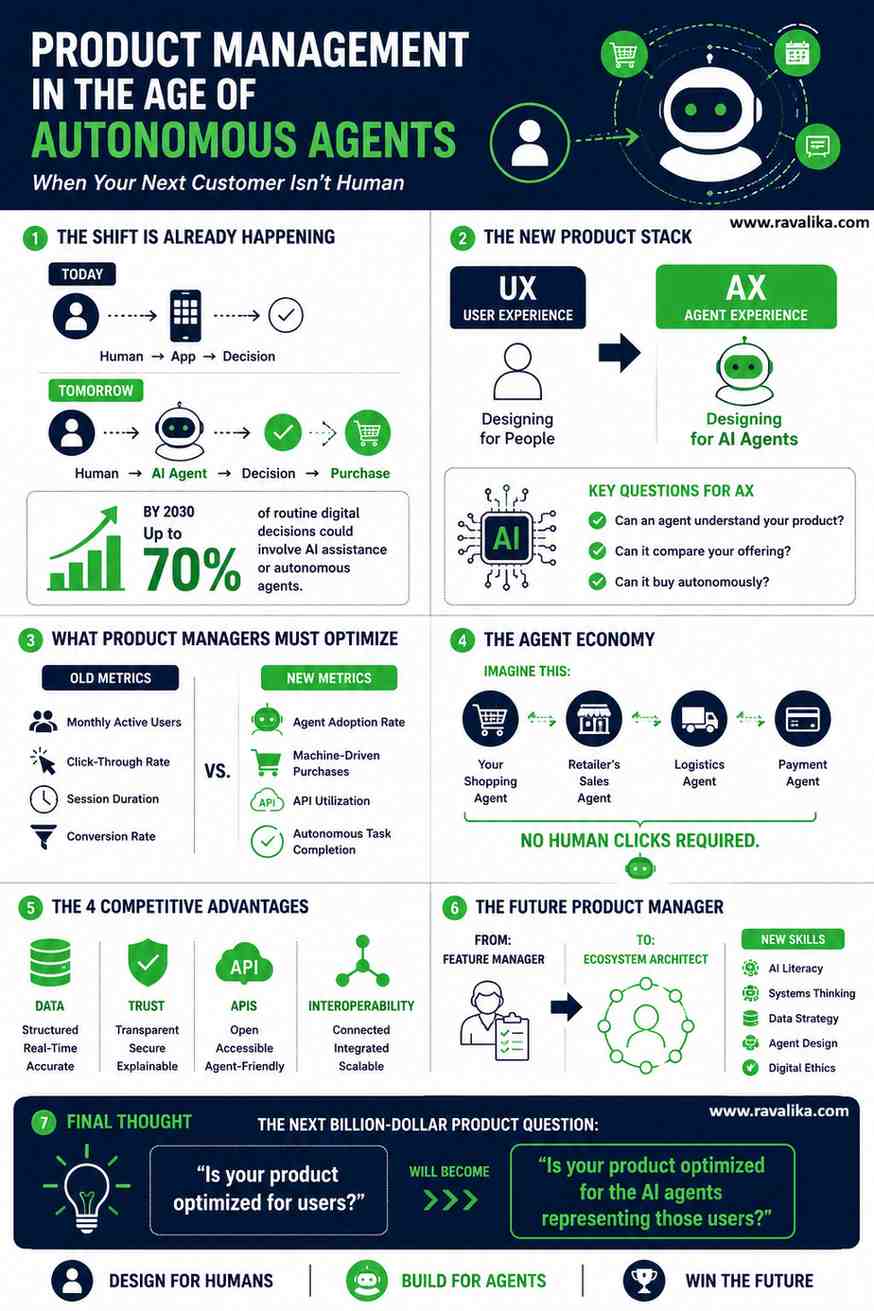
Designing for Agent Experience (AX)
For years, organizations have invested heavily in User Experience (UX). The goal has been to make products intuitive, engaging, and easy for humans to navigate.
In the age of autonomous agents, a new discipline is emerging: Agent Experience (AX).
Agent Experience focuses on how effectively intelligent systems can understand, access, evaluate, and interact with a product. While humans may appreciate aesthetics and emotional design, autonomous agents prioritize structured information, clarity, interoperability, speed, and reliability.
Product teams will need to consider:
- How easily can an agent understand the product?
- Can agents access product information programmatically?
- Are pricing and policies machine-readable?
- Can agents complete transactions autonomously?
- How transparent are product capabilities and limitations?
The products that become agent-friendly may gain significant advantages as AI-driven decision-making becomes more common.
From User Journeys to Agent Journeys
Traditional product management often revolves around customer journey mapping. Teams identify touchpoints, friction areas, and opportunities to improve user experiences.
Autonomous agents introduce a new dimension: agent journeys.
Imagine a future travel booking platform. Instead of a user manually comparing hundreds of options, an AI travel agent gathers requirements, researches alternatives, evaluates trade-offs, negotiates pricing, and completes bookings automatically.
In this environment, the product journey may involve interactions between multiple autonomous systems rather than direct human engagement.
Product managers must begin understanding:
- How agents discover products
- How agents evaluate options
- How agents make decisions
- What data agents require
- How trust is established between systems
Success will increasingly depend on optimizing interactions between intelligent entities rather than solely focusing on human workflows.
Data Becomes the Product
Data has always been valuable, but in an agent-driven economy, its importance will multiply.
Autonomous agents depend on accurate, structured, and accessible information. Products with incomplete, inconsistent, or unreliable data may struggle to compete because agents will favor platforms that provide trustworthy and machine-readable information.
This means product managers must prioritize:
- Data quality
- Metadata management
- Real-time updates
- API accessibility
- Information transparency
Organizations that treat data as a strategic product asset rather than a byproduct of operations will be better positioned for the future.
As agents increasingly make recommendations and decisions, data quality may become as important as product functionality itself.
The Emergence of Agent-to-Agent Commerce
One of the most fascinating developments on the horizon is agent-to-agent commerce.
Today, consumers browse websites, compare products, read reviews, and make purchases themselves. Tomorrow, personal AI agents may handle these tasks automatically.
A customer’s agent could communicate directly with a retailer’s agent to:
- Compare product specifications
- Verify inventory availability
- Negotiate pricing
- Arrange delivery
- Manage subscriptions
- Resolve support issues
In such a world, traditional marketing tactics may lose effectiveness.
Product managers will need to think beyond human persuasion and focus on creating objective value that intelligent systems can recognize and validate.
The ability to expose product information, reputation metrics, service quality indicators, and performance data in machine-consumable formats may become a competitive differentiator.
Rethinking Product Metrics
The metrics that define product success are also likely to evolve.
Traditional measurements include:
- Monthly active users
- Session duration
- Click-through rates
- Conversion rates
- Customer satisfaction scores
While these metrics remain important, they may no longer provide a complete picture.
Future product teams may track:
- Agent adoption rates
- Agent transaction volume
- Machine-driven conversions
- Agent engagement frequency
- Autonomous workflow completion rates
- Cross-agent interoperability scores
Understanding how autonomous systems interact with products will become just as important as understanding human behavior.
Organizations that develop these measurement frameworks early may gain valuable insights and competitive advantages.
Trust as the Ultimate Product Feature
The rise of autonomous agents introduces a critical challenge: trust.
Humans can often tolerate ambiguity, make intuitive judgments, and recover from mistakes. Autonomous agents require confidence in the information they receive and the systems they interact with.
Product managers must increasingly focus on:
- Explainability
- Transparency
- Security
- Reliability
- Compliance
- Ethical AI practices
Trust signals may become key factors in agent decision-making.
For example, agents may evaluate products based on security certifications, reliability scores, privacy policies, performance history, and verified customer outcomes before making recommendations.
In many cases, trust may become a more powerful differentiator than features themselves.
The New Role of the Product Manager
The role of product managers is also evolving rapidly.
Historically, product managers served as translators between business stakeholders, engineering teams, and customers. Their primary responsibility was aligning organizational goals with user needs.
In an autonomous future, product managers must expand their scope.
They will need expertise in:
- AI capabilities and limitations
- Agent ecosystems
- Data strategy
- Human-AI collaboration
- Digital ethics
- Platform thinking
- Systems design
Rather than managing isolated products, future product leaders may orchestrate complex networks of humans, agents, data sources, and intelligent systems.
The most successful product managers will become architects of interconnected ecosystems rather than simply feature owners.
Challenges That Cannot Be Ignored
Despite the excitement surrounding autonomous agents, significant challenges remain.
Questions around accountability, governance, bias, privacy, and security continue to demand attention.
Organizations must determine:
- Who is responsible when agents make mistakes?
- How should agent decisions be audited?
- How can bias be minimized?
- What level of autonomy is appropriate?
- How should sensitive information be protected?
Product managers will play a crucial role in addressing these questions.
The future will require balancing innovation with responsibility, ensuring that autonomous systems create value while maintaining human oversight and trust.
Companies that ignore these challenges may face reputational, regulatory, and operational risks.
Building Products for an Autonomous Future
Organizations do not need to wait for widespread agent adoption before preparing.
Forward-thinking product teams can begin today by:
- Investing in API-first architectures
- Improving data quality
- Enhancing interoperability
- Building transparent systems
- Exploring agent-friendly interfaces
- Experimenting with AI-powered workflows
- Developing governance frameworks
The companies that prepare early will be better equipped to thrive as autonomous ecosystems mature.
Much like the mobile revolution rewarded organizations that adapted early, the agent revolution is likely to create new market leaders while disrupting established players.
My Final Thoughts
The age of autonomous agents represents one of the most significant shifts in the history of digital products. For decades, product management has focused on understanding and serving human users. While that responsibility remains essential, a new reality is emerging where intelligent systems increasingly act on behalf of those users. Product managers must now design experiences that accommodate both human expectations and machine intelligence.
The future belongs to organizations that recognize this transformation early. Success will no longer depend solely on creating exceptional user experiences. It will depend on creating products that can communicate, collaborate, and build trust with autonomous agents operating across a connected digital ecosystem. Product management is evolving from designing screens and workflows to orchestrating intelligent interactions at scale. Those who embrace this change today will help define the next generation of innovation tomorrow.