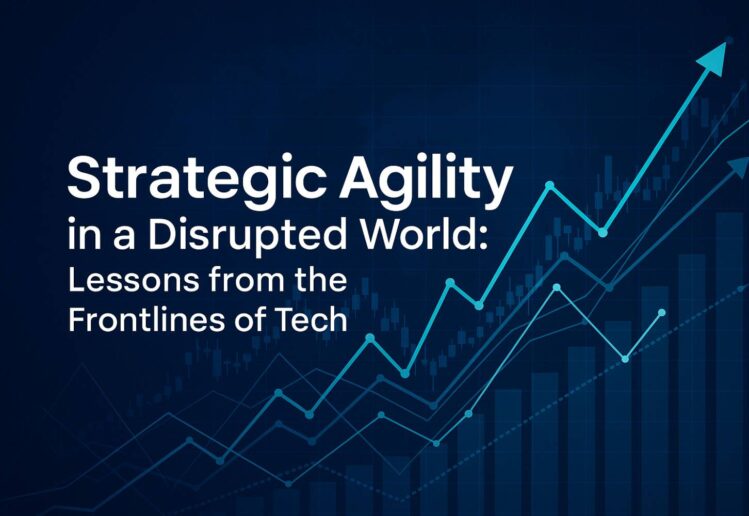
2025 is the year defined by unpredictability, strategic agility has emerged as a critical differentiator for businesses navigating disruption. The old playbooks – built for stability, linear growth & gradual innovation – are rapidly becoming obsolete. In their place, a new example is emerging, shaped by speed, adaptability & intelligent experimentation.
I have always had a front-row seat for the shifts occurring across industries. From the acceleration of AI to global supply chain disruptions, the forces reshaping our world demand a fresh mindset – one where strategy is fluid & technology is a co-pilot, not just a tool.
The Case for Strategic Agility
Strategic agility is more than operational flexibility. It is the ability to sense change early, reconfigure capabilities quickly & make informed, forward-looking decisions under uncertainty. It combines:
- Vision: A long-term, purpose-driven north star
- Adaptability: Quick course-correction based on feedback & signals
- Empowerment: Decentralized, responsive decision-making across teams
- Technology leverage: Using data, automation & intelligence to respond at scale
Businesses can no longer afford to rely on static strategies or rigid hierarchies. Strategic agility is about evolving your organization’s muscles to detect disruption before it hits & shifts with precision. It is not just a trait – it is a system that must be embedded across people, processes & platforms.
Disruption is the New Constant
In the past five years, businesses have endured:
- A global pandemic
- AI’s exponential leap (think ChatGPT, autonomous systems, etc.)
- Climate-related supply chain volatility
- Economic uncertainty
- Shifts in workforce expectations (hybrid, gig, automation)
These are not “blips.” They are catalysts of permanent change.
Organizations must now operate with the assumption that volatility is the rule, not the exception. The competitive edge will belong to those who are comfortable with discomfort & build systems resilient to chaos. Strategic agility is how leaders future-proof their business models.
Lessons from the Tech Frontlines
Technology companies often operate in a hyper-dynamic environment, where customer expectations shift rapidly & innovation cycles move at lightning speed. As a result, they offer valuable insights into how strategic agility can be applied – & scaled – in real-world conditions.
Let us look at some lessons drawn from technology-driven enterprises that exemplify strategic agility:
Experimentation is a Culture, Not a Phase
Leading tech companies don’t wait for the “perfect idea” or a fully mapped-out plan. They launch MVPs, gather feedback, fail fast & scale what works.
Lesson: Strategic agility thrives in cultures where learning is prioritized over perfection. Leaders must be comfortable with ambiguity & teach teams to treat experiments as inputs to strategy.
Digital Twins for Strategic Simulation
Some advanced organizations use digital twins – virtual models of real-world operations – to test out strategic moves before committing. Whether optimizing logistics or forecasting market behavior, these simulations reduce risk & improve decision-making.
Lesson: Technology can now simulate scenarios at scale. Agile strategy isn’t guessing – it is data-informed intuition, accelerated by digital intelligence.
Cloud & AI Enable Agility at Scale
From rapid deployment of new applications to real-time customer insights, cloud computing & AI have become agility enablers. Teams that once spent months building infrastructure now pivot in days.
Lesson: The right tech stack isn’t a cost center – it is a strategic asset. Invest in scalable, intelligent architecture to support fast execution.
Cross-Functional Thinking Breaks Silos
In tech firms, strategy isn’t dictated by the C-suite alone. Engineers, designers, analysts & product leads all contribute. This diversity of insight leads to better risk management & faster alignment.
Lesson: Build strategic intelligence across the organization, not just at the top. Agility demands decision-making close to the ground.
Strategic Agility Is Not Just for Tech Giants
Strategic agility isn’t exclusive to billion-dollar tech enterprises. In fact, startups, SMEs & legacy industries are often better positioned to pivot quickly – if they embrace a mindset shift. Agility is about design, not size. Even smaller businesses & traditional enterprises can embrace this mindset. Here is how:
Think in Horizons, Not Annual Plans
Break down long-term goals into adaptive sprints, reevaluated every quarter. Use OKRs (Objectives & Key Results) that can evolve based on context.
Build a Modular Business Model
Design your processes, teams & tech infrastructure to plug & play. If one-part falters due to disruption, others can operate independently.
Create a Feedback-Rich Environment
Use data dashboards, customer signals & team retrospectives to course-correct early & often. Feedback is fuel for strategy.
Monitor Weak Signals
Agile companies don’t just look at headline trends. They pay attention to fringe shifts, emerging behaviors & ecosystem movements. Often, the next disruption begins as a whisper, not a bang.
Mindsets That Power Strategic Agility
Tools & processes only take you so far – agility is powered by people. The beliefs & behaviors of leaders shape whether strategy stays rigid or evolves with purpose. To build agility, you must first build the mindset that enables it.
Here are four key shifts leaders must make:
- From Control to Enablement – Leaders must trust teams to act without micromanagement. Provide clarity of purpose, not step-by-step instructions.
- From Plans to Possibilities – Strategic agility isn’t about tossing strategy. it is about embracing multiple futures & preparing for each.
- From Hierarchy to Networks – Empowerment flows faster in networked, collaborative structures. Flatten where possible. Fluid roles outperform fixed ones in uncertain times.
- From Prediction to Preparation – No one can fully predict what’s next. But those who prepare, test & adapt fastest will always stay ahead.
Real-World Example – Microsoft’s Agility Pivot
Microsoft’s transformation journey offers a powerful case study in strategic agility. Under Satya Nadella, the company shifted from a rigid, Windows-first mindset to an open, cloud-native, AI-forward organization. This wasn’t luck – it was a result of proactive leadership & cultural rewiring.
What powered this?
- A growth mindset culture
- Embrace of customer-centric learning
- Strategic bets on cloud, AI & enterprise collaboration
- Cross-functional accountability
The takeaway? Agility is a strategic choice, not an accidental outcome. It requires vision, courage & consistency.
The Strategy of Becoming Unstoppable
Strategic agility is about moving with purpose, informed by insight & flexible enough to capitalize on the unexpected. In an environment where the only constant is change, leaders must stop asking, “What’s the right answer?” & instead ask, “How fast can we learn?”
Technology isn’t the only answer – but it is a vital one. Combined with bold leadership, adaptive structures & an empowered workforce, it can transform how organizations navigate uncertainty. The most successful companies of tomorrow will be those that adapt today – with agility, intelligence & intent.