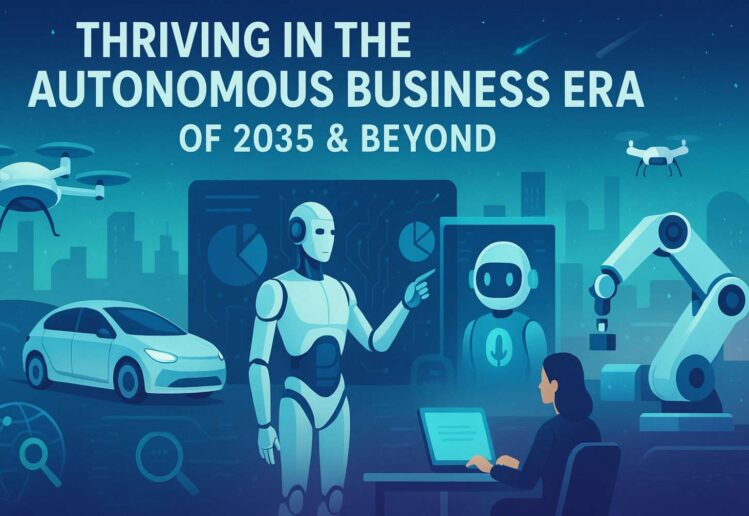
2035 – exactly 10 years from now – the world is going to be autonomous. Businesses aren’t simply operating – will be are self-operating. Powered by Artificial General Intelligence (AGI), quantum computing, advanced robotics and hyper-connected IoT ecosystems, companies in 2035 can make strategic decisions, execute operations and adapt in real-time – with minimal human intervention.
This transformation is a deep shift in how value is created, delivered and sustained. The autonomous business era represents the convergence of automation, intelligence and adaptability – a realm where organizations can function as self-learning, self-healing systems.
But here’s the catch – while automation handles the how, human leaders must still define the why. Thriving in this era will require an evolved role for human ingenuity, ethics and vision.
Understanding the Autonomous Business Era
An autonomous business is one that can sense, decide, and act – independently – across most of its value chain. This isn’t just about robotic process automation or AI chatbots; it is about a fully integrated, self-regulating enterprise.
By 2035, advancements in:
- AGI (Artificial General Intelligence) enable dynamic, context-aware decision-making.
- Quantum computing allows instant simulation of millions of scenarios for risk-free optimization.
- Next-gen IoT creates a sensory web across every asset, product, and customer interaction.
- Bio-digital interfaces let humans influence autonomous systems intuitively and securely.
Example:
A global supply chain in 2035 doesn’t wait for a manager to detect delays – sensors trigger alternative sourcing, quantum algorithms recalculate routes, and robotic fleets adapt instantly, all without human command.
Key Drivers Behind the Shift
The journey to autonomy is fueled by multiple forces converging over decades:
- Technological Maturity – AI, robotics, and blockchain have evolved into reliable, adaptive systems.
- Economic Pressures – Volatility demands resilience; autonomous systems mitigate disruptions faster.
- Workforce Evolution – As routine tasks vanish, humans shift to creative, strategic, and ethical roles.
- Customer Expectations – Instant, personalized, and consistent experiences become the global norm.
- Sustainability Goals – Autonomous optimization slashes waste, energy use, and emissions.
The Anatomy of an Autonomous Enterprise
By 2035, thriving autonomous businesses share common capabilities:
a. Perception & Sensing – Real-time monitoring of everything – from production machinery vibration to employee sentiment and even ecosystem biodiversity around facilities.
b. Cognitive Decision Engines – AI systems that understand context, predict outcomes, and make optimal decisions in milliseconds.
c. Robotic Execution – Physical and software-based robots that execute tasks flawlessly – from automated contract negotiation to self-repairing industrial equipment.
d. Continuous Learning Loops – Systems that constantly adapt from new data, refining strategies without waiting for quarterly reviews.
e. Ethical & Transparent Governance – Built-in compliance, bias detection, and explainable AI ensure trust with regulators, employees, and customers.
The Human Role in an Autonomous World
A common fear about autonomy is job displacement. While some roles will vanish, human value will not. The human workforce in 2035 is – in essence, humans shift from operators to orchestrators.
- Visionary – Defining the mission, purpose, and long-term direction of autonomous entities.
- Ethical Custodians – Setting guardrails and resolving moral dilemmas algorithms cannot grasp.
- Creative Innovators – Imagining new business models and experiences beyond algorithmic prediction.
- Relationship Builders – Fostering trust, partnerships, and human connection.
New Business Models of 2035
Thriving in the autonomous era will demand embracing fresh models that leverage self-operating capabilities:
- Zero-Latency Enterprises – Businesses capable of making and executing decisions instantly in response to market changes.
- On-Demand Corporations – Dynamically assembling teams, assets, and capabilities only when needed, dissolving them afterward.
- Circular Autonomy – Fully automated product life cycles – design, manufacturing, reuse, recycling — all optimized for sustainability.
- Ecosystem-as-a-Service (EaaS) – Autonomous networks of companies collaborating without direct human negotiation.
- Personalized Autonomous Brands – AI-driven micro-brands that tailor products uniquely for each customer, at scale.
Leadership Mindsets for 2035 and Beyond
Leaders can’t simply rely on quarterly planning cycles or legacy hierarchies. The autonomous era demands:
- Agility over Rigidity – Adapt in days, not years.
- Outcome-Based Leadership – Focus on the value delivered, not hours logged.
- Trust in Autonomy – Avoid micromanaging systems designed to self-optimize.
- Ethical Vigilance – Be proactive in preventing misuse of autonomous power.
- Future Literacy – Continuously anticipate, model, and rehearse multiple future scenarios.
Workforce Transformation Strategies
Preparing your people for the autonomous era is non-negotiable:
- Upskilling in AI Collaboration – Training employees to work with AI rather than compete against it.
- Creativity & Critical Thinking – Strengthening the human skills algorithms struggle to replicate.
- Ethics & Governance – Making every employee a guardian of responsible AI.
- Interdisciplinary Fluency – Combining tech, business, psychology, and environmental awareness in decision-making.
Navigating Risks & Challenges
While autonomy brings efficiency and growth, it also introduces new challenges:
- Over-Reliance Risk – Blind faith in systems can amplify errors at scale.
- Security Threats – Autonomous systems are high-value targets for cyber-attacks.
- Algorithmic Bias – Unchecked AI can perpetuate inequities without human oversight.
- Regulatory Complexity – Laws may lag behind technological realities.
- Ethical Dilemmas – Machines may struggle to navigate nuanced moral conflicts.
Businesses must embed human-in-the-loop oversight in critical functions.
Thriving Beyond 2035 – The Road Ahead
The autonomous business era won’t plateau in 2035. By 2040 and beyond, expect:
- Interplanetary Supply Chains – Autonomous systems managing lunar mining and Mars manufacturing.
- Bio-Autonomous Systems – AI-integrated biological processes in healthcare, agriculture, and environmental restoration.
- Emotionally Adaptive AI – Systems that sense and respond to human emotional states in real time.
- Holistic Planetary Governance – AI helping to balance economics, ecology, and human well-being globally.
How to Prepare Now?
Even though 2035 sounds far away, the seeds of autonomy are being planted today. Businesses should start by:
- Adopting Early AI Integration – Implement AI for decision support now to ease future transition.
- Building Data Ecosystems – High-quality, diverse, real-time data will be the fuel of autonomy.
- Investing in Human Creativity – Encourage innovation, experimentation, and cross-disciplinary collaboration.
- Strengthening Cybersecurity – Protect autonomous assets from evolving threats.
- Engaging in Policy Shaping – Participate in shaping the legal and ethical frameworks of autonomy.
Human Vision, Machine Precision
The autonomous business era of 2035 and beyond represents the greatest shift in organizational design since the Industrial Revolution. It is not about replacing humans but redefining what it means to be human in business. In a world where machines can think, act, and learn at unprecedented speeds, the human advantage will lie in purpose, empathy, and imagination.
Those who thrive will be the ones who understand that autonomy is not an end – it is a platform for a new era of limitless human potential.